
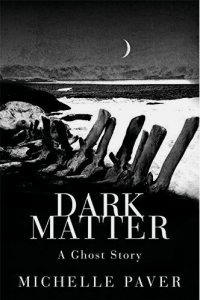
There’s nothing quite like the bitter cold and pitch-black nights to really set the horror at a 10, is there? For me, the first introduction was “The Thing” followed by the X-files episode “Ice.” The frozen parts of our world hide a multitude of mysteries and more than a few sins, and desolation is nearly as terrifying as the things that make use of such isolated places and people. Dark Matter plays on all of that: the desires we hide, the darkness that threatens us with oblivion, and the things that lurch and crawl when the night never ends and secrets are easily hidden beneath the ice.
It’s almost 1940, and Jack Miller is seeking a change. He’s been through it in the past couple of years, and all he wants is a place where he feels he’ll be useful and appreciated. Fortunately, he’s not terrible at being a wireless operator. Unfortunately, his pick for an arctic expedition to study weather patterns might be his reach exceeding his grasp, because holy shit, does that expedition break him in every possible way.
His first issue is the class divide between him and his comrades. Adventuring then (and now) is a rich man’s hobby, and Jack is far from the moneyed aristocracy who can typically afford all the things a team needs to luxuriate in an environment otherwise whole-ass in on the scarcity. He lets these differences pass when it comes to his friend Gus, but finds them pompous when handled in almost the exact same way by another adventurer. Part of that pass he gives Gus is he’s got it pretty bad for the golden boy of the expedition and the lack of such things for Albie (not his favourite) is how the richer man hinders said affections from developing naturally.
His second issue is that the Arctic is not a fucking playground. It’s the kind of cold that kills an unprepared man before they even know they’re dead. The ice in the bay keeps people from going in and out, and an accident when it’s frozen over means death. The days are short, then non-existent, submerging Jack in an intense darkness where time and space lose all meaning to him. The old money he travels with might find all of this some sort of bonanza of scientific exploration, but even they are brought back to reality when Gus suffers an infection that forces him and Albie back to the known world, leaving Jack by himself to develop unchecked mental health issues.
Jack’s third issue is the haints. Maybe Jack would have paid attention to the red flag from the captain of the ship that escorts them to Gruhuken— it’s a cursed place with a dark history— if he weren’t so mad about the sled dogs or Albie. Miners used to inhabit the location, and something dark lingered long after they left. Jack first starts encountering this “memory” while there is still daylight to be had, but it starts pursuing him more wholeheartedly when Jack is left alone due to the medical emergency. Then the daylight gives out to 24 hours of dark and darker.
I loved this book. Despite Jack telling us the story through his journal entries, atmosphere becomes another narrator, and the Arctic is fucking terrifying. These men framed it as an adventure, but really it’s worse than any of the ghosts that might remain. It tells its own blood-soaked stories in the extremes it forces humans to endure and enact. For every bit I thought Wakenhyrst was a bit droll with its exposition, the slow burn of this was like freezing to death under the eyes of past horrors, and that is such a beautiful kind of dawning horror to feel as a reader.
Would I Read it Again?: Gods yes. I’ve recommended it to several people, but trying to get my family to read my recommendations is like pulling teeth, especially since my tastes are super weird. This feels like a book where you pick up more context each and every time, where the reveal doesn’t spoil anything because it’s not the horror part of the story.
Rating: 4.5. It is a slow burn, and I think a lot of people might get turned off based on that, especially if they are looking for high drama all of the time. However, that burn is built into the narrative, and it’s appropriate here. If it were faster paced, it would lose some of the “chipping away at your sanity” that’s the point of the whole thing.

 The Wuthering Cephalopod